Choosing between SEO vs AEO vs GEO is no longer academic. If your brand wants visibility in 2026, you must decide where to invest first, how to structure pages for AI assistants, and which metrics prove impact.
Here is a practical guide to what each approach does, how they differ, and how to implement them so real customers in India can discover, trust and contact you—whether they search on Google, ask Gemini, prompt ChatGPT or browse Perplexity.
SEO vs AEO vs GEO: the short answer
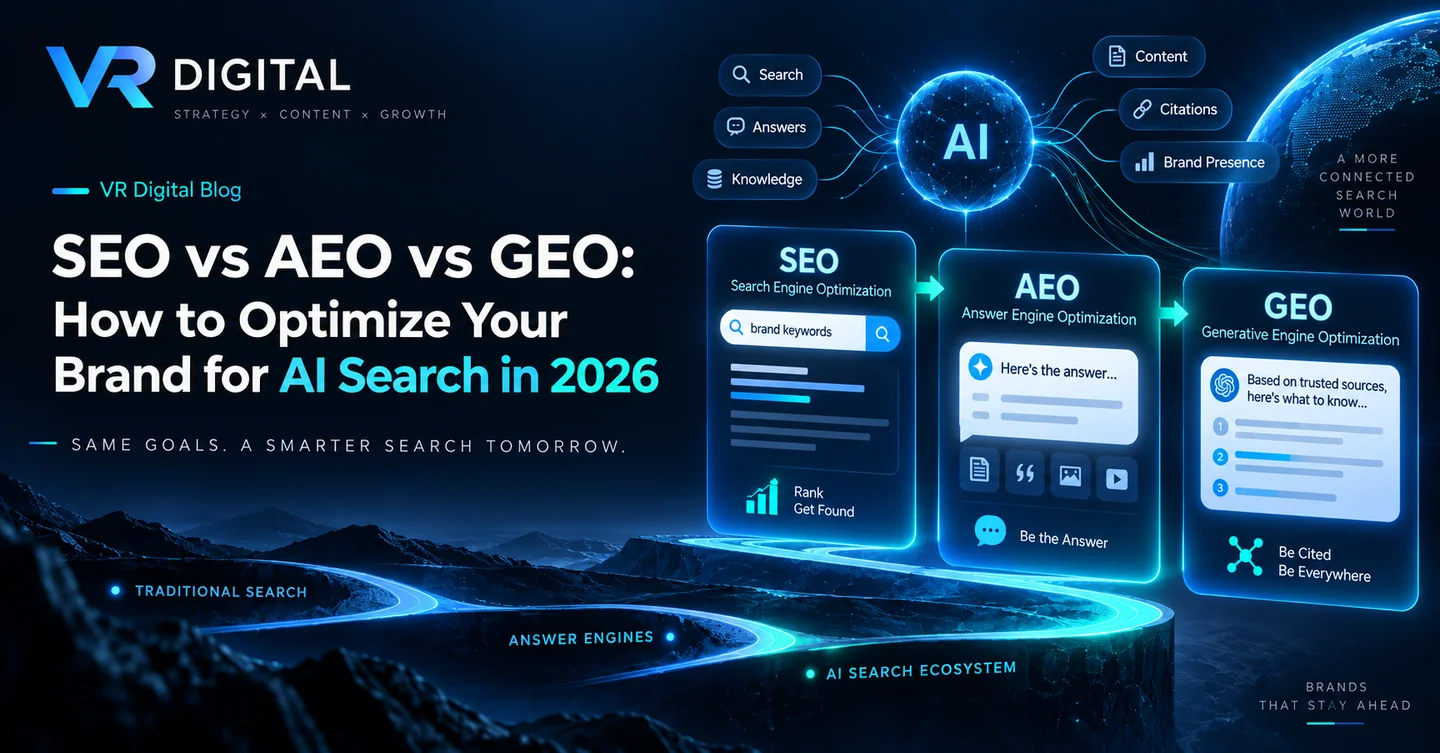
Direct answer: SEO makes your pages discoverable and rankable in traditional search. AEO (Answer Engine Optimisation) makes your content easy for AI assistants to quote accurately. GEO (Generative Engine Optimisation) increases the chance your brand is summarised or cited in generative results.
- SEO: Crawlability, intent-mapped pages, internal linking, and authority. Measures: impressions, rankings, non-brand traffic, conversions.
- AEO: Concise, source-backed answers, Q&A blocks, definitions, and consistent entities. Measures: inclusion in AI answers, citation rate, assisted conversions.
- GEO: Content and data formats that LLMs can synthesise, plus broad corroboration. Measures: mentions in summaries, link presence where available, assisted revenue.
When resources are tight: fix critical SEO first (speed, indexing, intent-match), implement AEO patterns on priority pages, then expand into GEO by strengthening corroboration and entity coverage across the web.
How AI search works in 2026
Direct answer: AI assistants and search-integrated models (for example, Gemini, ChatGPT, Copilot and Perplexity) generate answers by combining retrieval from the web with model reasoning. They prefer clear entities, consistent facts, and corroborated sources.
Practically, this means pages that state answers succinctly, cite credible sources, expose structured data, and stay consistent across your site, profiles and major directories are more likely to be included or referenced in AI responses.
Optimising for AI answers is not a replacement for SEO. It sits on top of sound technical foundations and commercially relevant content.
Decision framework: what to prioritise
Direct answer: Your priority order depends on business model, conversion economics and current site quality. Use this as a starting point, then adjust after auditing your data.
- Local services (doctors, salons, clinics, home services): GBP accuracy, reviews and service pages first; then AEO-style FAQs; then GEO via corroboration on aggregators and local media.
- Ecommerce: Fix crawl/indexing, clean faceted navigation, and product schema. Add comparison tables and short answers. GEO comes from consistent product facts across marketplaces and your site.
- B2B/SaaS: Own definitional queries, pricing and implementation pages. Add proof-driven FAQs and onboarding guides. GEO priority for category definitions and alternatives pages.
- Media/education: Strong E-E-A-T signals, summaries at top, citations and updated dates. GEO via datasets, glossaries and author profiles.
Trade-offs: AEO work is content-heavy but faster to ship on key pages. GEO requires broader distribution and consistent facts across third-party sites, which takes outreach time. Expect 60–90 days before you see stable inclusion in AI answers.
Implementation checklist: from crawl to conversion
Foundation: technical SEO and content clarity
- Crawl the site and fix indexation, status codes, canonical conflicts, and thin/duplicate pages. Prioritise templates that drive revenue.
- Improve load performance, image compression and Core Web Vitals. Fast pages increase the chance users stay to read your concise answers.
- Map each page to a single intent and subject. Add a one-paragraph summary answer at the top for “ChatGPT SEO” and “Gemini SEO” style queries.
- Strengthen internal linking with descriptive anchors to move equity to definitional and money pages.
AEO: structure, sources and succinctness
- Create Q&A blocks answering one intent per question in 40–80 words. Include definitions, steps, pros/cons and eligibility where relevant.
- Back answers with first-party data: process, pricing ranges, policies, ingredients, specs. Where possible, cite or reference authoritative Indian standards or regulations relevant to your sector.
- Ensure entity consistency: brand, people, products, locations, NAP and SameAs across your site and major profiles.
- Add FAQPage, HowTo, Product/Service and Review schema where appropriate. Keep content and schema aligned.
- On priority pages, include a short “Sources & assurances” note if claims need context. LLMs favour clear provenance.
GEO: data, freshness and credibility
- Publish concise “What is X?”, “X vs Y”, and “Best for [use case]” sections. These power generative comparisons like SEO vs GEO or AEO vs GEO.
- Keep facts fresh: pricing, specs, availability, service areas and dates. LLMs discount stale or contradictory data.
- Corroborate across the web: consistent profiles on GBP, LinkedIn, industry directories, marketplaces and press mentions. Aim for the same core facts everywhere.
- Expose machine-readable data: Organisation, LocalBusiness, Product, Service, Author, BreadcrumbList, FAQPage. If you publish datasets or glossaries, make them crawlable.
Conversion and performance signals
- Make contact options obvious: phone, WhatsApp, form, store locator, and clear next steps. This helps turn AI-assisted discovery into revenue.
- Align landing pages to intent with strong above-the-fold summaries and social proof.
- Test UX and forms as part of website development and conversion optimisation. Poor forms waste any visibility gains.
- Where needed, bring in search engine optimization services to accelerate audits, content ops and internal linking at scale.
Schemas and data AI agents read
Direct answer: Use schema to declare entities and relationships, not to stuff keywords. Prioritise what maps to your offerings and proof.
- Organisation/LocalBusiness: legal name, logo, NAP, service area, SameAs, GSTIN in body content where appropriate.
- Product/Service: name, description, brand, price, currency (INR), availability and review snippets if you have them.
- FAQPage / HowTo: match on-page Q&As and steps. Keep each answer self-contained.
- Person/Author: expertise, role, credentials and SameAs links to verified profiles.
- BreadcrumbList: helps context and topic clustering.
Avoid marking up content that users cannot see. Keep schema in sync with page edits. When you change prices or service areas, update both the copy and the structured data the same day.
Measurement: KPIs for AI visibility
Direct answer: Track inclusion and impact, not just rankings. Combine manual LLM audits with analytics and search platform data.
- Inclusion rate: Monthly audit a fixed set of 30–50 priority queries in ChatGPT, Gemini, Copilot and Perplexity. Record whether your brand is cited or summarised and save screenshots.
- Assisted conversions: In GA4, build Explorations to attribute journeys that include informational content prior to lead or sale.
- Entity coverage: In Search Console, monitor queries containing your brand, product names and core entities. Look for coverage expansion and fewer irrelevant queries.
- Referral signals: Track traffic from engines that pass referrers (e.g., Perplexity) and from Bing’s AI surfaces. Treat it as directional, not exhaustive.
- Quality metrics: Dwell time on answer sections, FAQ CTR, scroll depth, and form completion rate.
Set 90-day review cycles. Publish, measure inclusion and conversions, refine answers and corroboration, repeat. If you need a done-with-you program focused on AEO, GEO and AI search optimisation, consider engaging a specialist team.
India-specific considerations
Direct answer: Optimise for multilingual search behaviour, marketplace corroboration and trust signals that matter locally.
- Languages: Prioritise English plus one or two major Indian languages relevant to your markets (e.g., Hindi, Tamil, Bengali). Keep key pages consistent across languages.
- Marketplaces: For ecommerce, align product facts across your site and marketplaces like Amazon, Flipkart or ONDC listings to strengthen GEO corroboration.
- Trust: Display registered address, GSTIN where useful, return/refund policies, and UPI/secure payments. Add review summaries from verified sources.
- Contact: Prominent WhatsApp and phone CTAs convert better for many categories in India—measure their usage alongside forms.
For local services, accurate service-area pages, vernacular FAQs, and fresh reviews often move the needle faster than broad content expansions.
Conclusion
Here is the bottom line on SEO vs AEO vs GEO: fix foundational SEO, layer AEO patterns on high-intent pages, then build GEO strength by keeping facts consistent across the web and formats AI agents prefer.
If you want a practical plan tailored to your site and market, VR Digital can help you audit, prioritise and execute without hype. Start with one 90-day cycle and expand what proves impact.
Use different evidence for different outcomes
Traditional search reporting can track impressions, clicks and enquiries. AI-answer visibility needs dated, reproducible observations and should not be treated as stable rankings. Keep sources and claims accurate, and do not create duplicate pages solely to target different AI products.
Explore our AI search optimization or request a website review to identify the next step for your business.
Applying this guidance to your business
Answer engine optimisation and generative engine optimisation overlap with the foundations of useful, accessible web content. Perplexity SEO work should focus on clear explanations, reliable sources and evidence that readers can inspect, rather than promises of guaranteed citations.
Explore our AEO, GEO & AIO service for the scope and process.
Sources and editorial context
For the platform guidance relevant to this article, see Google’s people-first content guidance.
This update used AI assistance to clarify the explanation and supporting references. It is general guidance, not a report of a new client experiment. Check the current platform documentation and your own account data before applying it. Learn about VR Digital or send a correction or question.
SEO, AEO and GEO for local businesses
For businesses that serve one city — clinics, coaching institutes, showrooms — the same three layers apply with a local twist: a complete Google Business Profile and consistent listings feed Google Maps and AI answers alike, area-level service pages answer “near me” questions, and genuine reviews give both search engines and AI assistants confidence to recommend you. See our local SEO services and generative engine optimization services.