Picking a digital marketing agency isn’t about the glossiest slide deck. It’s about the one that moves the numbers that matter to your business. The right partner lines up channels, tracking, and creative with your revenue model—and tells you, in plain language, what it’ll take.
If you’re buying in India, you’re juggling budget discipline with the need for speed. Vendor fit, transparent reporting, and an execution plan that respects your sales cycle and regional audiences will make the difference between progress and churn.
Ask these before hiring a digital marketing agency
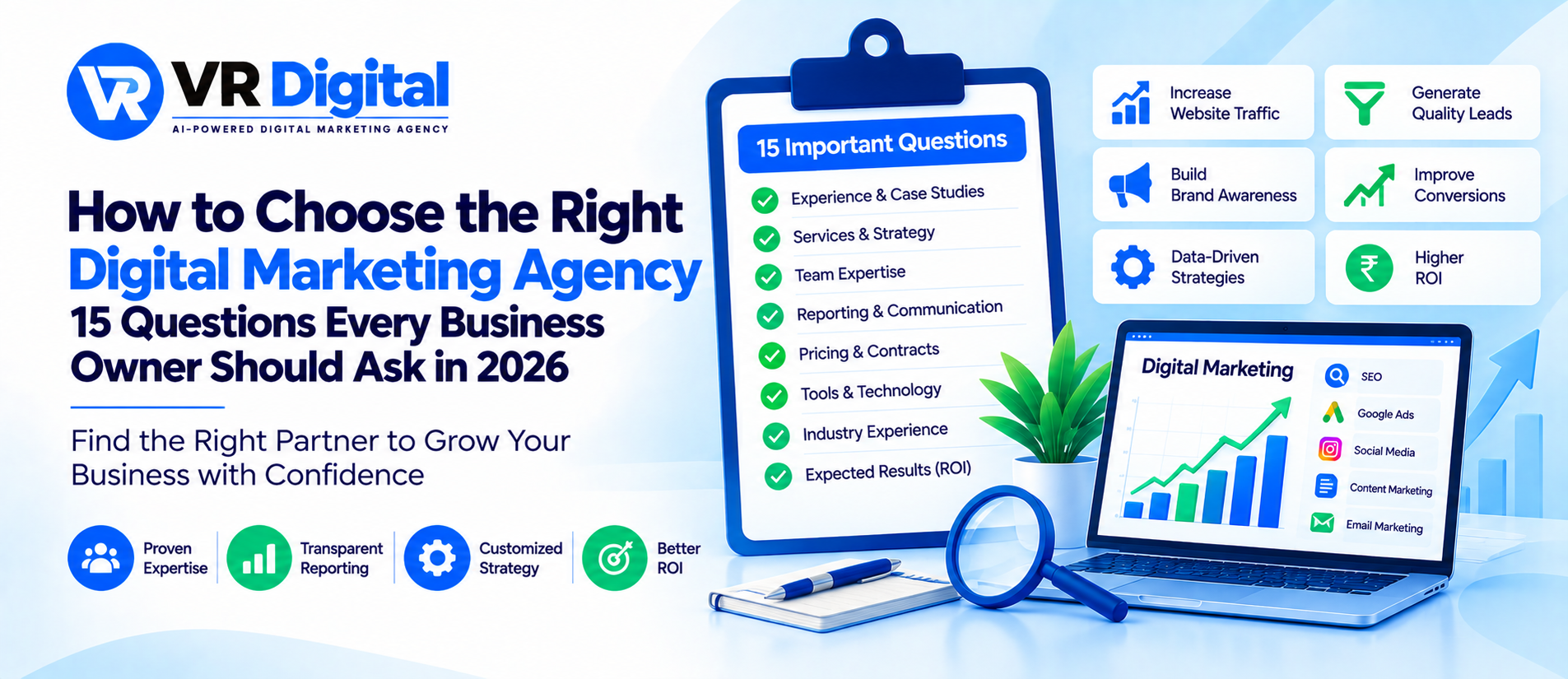
Start with these 15 questions to cut through the hype and judge fit.
- Which business goal comes first, and how exactly will we measure it?
- In the first 90 days, which channels will you run—and why those over the alternatives?
- Before we scale spend, how will you validate conversions in GA4 and our CRM?
- Who’s on my account week to week, and how much senior time is actually included?
- What’s the plan for landing pages, content, and creative testing?
- How will you handle attribution across paid, organic, and direct traffic?
- Which assumptions drive your forecast, and what could break them?
- How do you build and prioritise the monthly testing roadmap?
- What level of access will we have to ad accounts, analytics, and raw data?
- How will you report outcomes versus activities, and how often?
- What’s in scope, what isn’t, and how do change requests work?
- How are your fees structured relative to media spend and complexity?
- What compliance or privacy steps do you take for Indian users?
- Can you share anonymised deliverables similar to our case?
- If results lag, what happens in the first 30, 60, and 90 days?
Validate strategy, tracking and reporting before signing
Strategy and plan realism
Ask for a written 90-day plan tied to one commercial goal, your ICP, and your buying journey. The channel mix should match your market—search to capture in-market demand, paid social for discovery, remarketing to recover interest, and email/WhatsApp to nurture. Selling across regions or languages? Localisation should be baked in.
If your sales cycle runs from awareness to repeat purchase, make sure the plan covers full-funnel performance marketing with clear handoffs between acquisition, nurture, and sales enablement. Ask for example test matrices, not vague promises.
Pressure-test the assumptions. Anyone claiming organic traffic will carry revenue inside 8 weeks is guessing. Ignore lead-to-win rate or AOV and the forecast turns noisy. Good plans show ranges and dependency risks, not single-point predictions.
Tracking and attribution setup
Make conversion integrity non-negotiable. In GA4, define primary conversions that mirror real business outcomes—qualified lead forms, demo bookings, completed purchases, or key micro-conversions where they’re relevant. In Google Ads, map specific conversion actions, use enhanced conversions where appropriate, and set sensible values for bidding.
For lead gen, connect ad platforms to your CRM so closed-won revenue ties back to campaigns. Use UTM standards and solid naming conventions, and make sure call tracking or WhatsApp tracking is in place if those are core touchpoints. Align consent and data retention with Indian privacy expectations under the DPDP Act.
Reporting cadence and what to watch
Early on, insist on weekly or biweekly check-ins, then a monthly review that covers learnings, decisions, and next tests. Dashboards should separate leading indicators (CTR, CVR, CPA by segment) from lagging ones (pipeline, revenue). If you’ve run accounts before, you know how quickly vanity metrics can hide wasted spend—don’t let them.
Pricing models in India: trade-offs to consider
Pick a model that matches your complexity and appetite for control. Retainers stay predictable for ongoing execution and strategy. Project fees suit build-outs like analytics, creative sprints, or migrations. Percentage-of-spend fits when media budgets are large and the team is juggling many moving parts. Pure performance fees sound tempting but can drive low-quality volume if definitions aren’t tight.
Whichever you choose, lock scope and guardrails—channel coverage, deliverables per month, seniority mix, tool costs, and approval SLAs. If a performance marketing agency pegs fees to ROAS, define how returns are calculated, the attribution windows, and what counts as a qualified lead or purchase to avoid disputes.
Channel and capability fit by growth stage
Search and content
When demand already exists, search becomes your compounding channel. Check whether the team can map intent to content, structure internal links, and clear tech blockers. If you need a specialist, an experienced SEO agency can help; integrated support is valuable when content, PR, and dev dependencies are heavy.
If organic growth is a pillar, ask how they deliver search engine optimization services without chasing vanity keywords. Expect a plan for topical depth, crawl efficiency, and conversion-focused content.
For brands early in content, look for realistic timelines and a clear resourcing plan for briefs, subject-matter input, and publishing velocity. Thin posts published fast won’t move commercial terms.
Paid media and CRO
Paid channels can validate offers quickly. Look for tight feedback loops—audience and keyword testing, match types, exclusions, creative variants, and landing-page experiments. Expect a testing backlog with clear hypotheses and sample-size checks before rolling out winners.
Results hinge on pages that persuade. If your site is dated or slow, explore website development and conversion optimisation support so ads don’t carry all the weight. Simple wins often include faster load, clearer value props, and stronger forms.
Budget owners should ask for a pacing plan across the month and safeguards for seasonality and sales capacity. Sudden spikes without ops alignment burn leads and reputation.
Local and offline blended
For service areas and stores, local discovery drives calls and visits. Go beyond listings—ask for a reviews strategy, local landing pages, and map-pack visibility. Tie efforts to call tracking and store-level conversions where possible to prove lift instead of guessing.
If proximity is core, confirm how the team handles local SEO and Google Business Profile optimisation alongside region-specific content and offers. Regional languages and festival calendars matter in India.
Offline-to-online loops—missed-call lead capture, WhatsApp nurture, and post-purchase review asks—should be included early, not bolted on later.
Creative and brand systems
Creative drives click-through and conversion. Ask how they’ll build and test variations—hooks, formats, lengths—and how learnings will feed back into content and landing pages. Content velocity beats sporadic bursts.
If you lack design capacity, consider graphic design with AI to produce on-brand variations quickly while keeping human quality control. The point is to test more ideas without bloating timelines.
Guard the brand with clear guidelines, a quick approvals path, and a shared asset library. That removes the lag that kills momentum.
Quality signals and red flags
Quality partners share account access on day one, document their assumptions, and welcome audits. They’ll ask hard questions about your margins, sales capacity, and pipeline. They propose experiments with real decision thresholds, not endless tinkering. They’re transparent about misses and what they learned.
Red flags include templated proposals that ignore your category, a push for long lock-ins before a pilot, or reluctance to name the day-to-day owners. If a digital marketing company leads with price before problem-fit, keep the conversation short. The best digital marketing agency for you will turn uncertainty into a test plan, not a promise.
Governance, access and ownership
Get the practical details in writing. You should own ad accounts, analytics properties, domains, creatives, and raw data. Grant the agency admin or editor access rather than building on their logins. Confirm the tools they’ll use and who carries the licence cost. Clarify security expectations and backup responsibilities.
Agree on SLAs for response times, change requests, and crisis handling. Decide meeting cadence, who signs off ads and pages, and how experiments are prioritised. In India, align invoicing cycles, GST compliance, and payment modes up front. If you prefer an online marketing agency outside your city, set overlap hours to avoid decision delays.
Smart contracts include a 30-day termination clause, clear IP ownership, and a clean handover process. That protects both sides and lowers switching costs if priorities change.
Talk to a VR Digital Strategist →
Conclusion
Choosing a digital marketing agency comes down to proof of thinking, conversion integrity, and how quickly the team can run disciplined tests. Use the questions above to separate activity sellers from outcome partners.
If the answers line up with your goals and budget, shortlist two or three partners and run a structured 6–8 week pilot. VR Digital is built for founders who want clear plans, honest tracking, and accountable delivery—start small, validate fit, then scale with confidence.