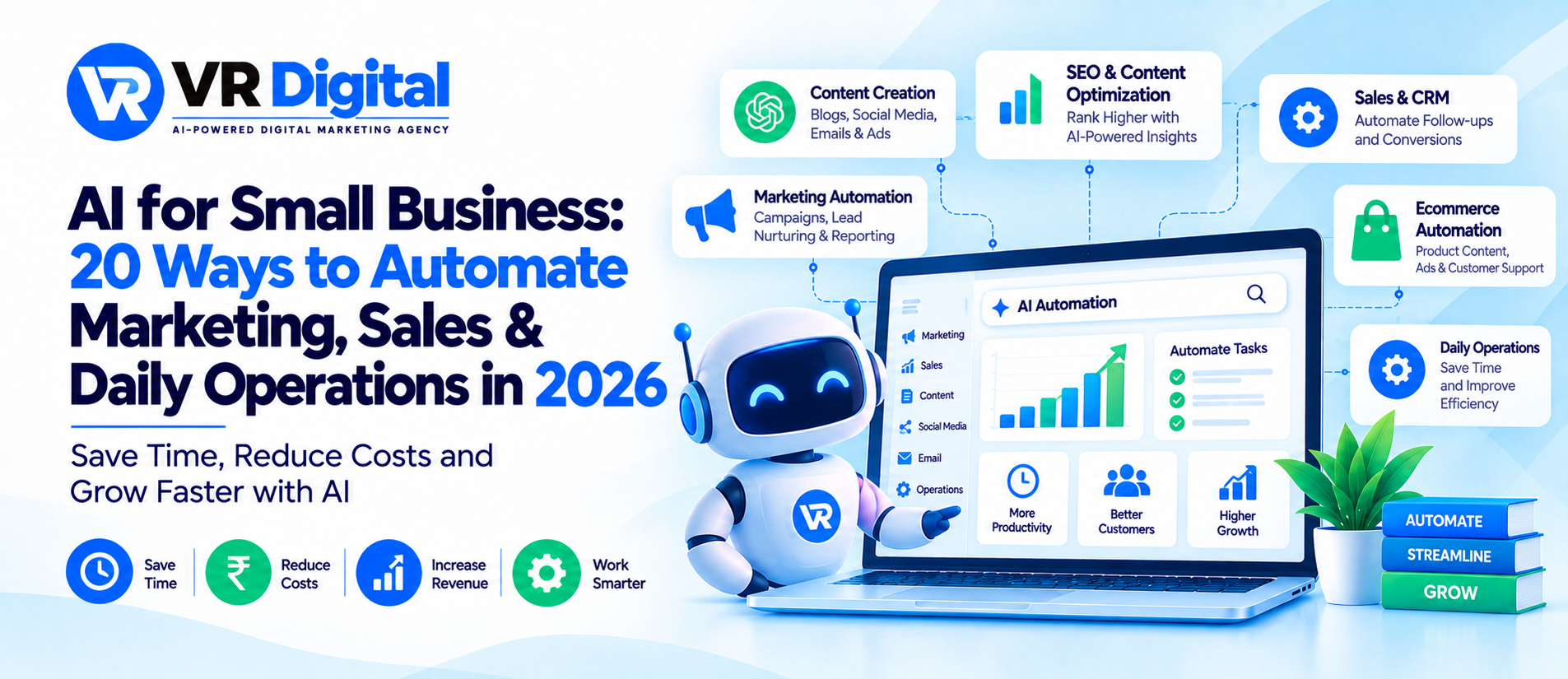
For most founders, AI for small business stopped being a novelty long ago. It’s now the fastest way to shave busywork, reply sooner, and keep costs steady. This 2026 playbook maps where AI gives back hours first, what to automate after that, and how to launch it without blowing up your stack.
Before we dive into tactics, set expectations. Not every workflow fits every market. India has its own realities—WhatsApp-first customers, regional languages, GST invoices, and price-sensitive CAC. Use this guide to shortlist use cases, then test each one against your data, tools, and margins.
AI for small business in 2026: what it means and why now
Here’s the direct answer—use AI to convert recurring, rules-based tasks into reliable workflows across marketing, sales, and operations. Start with processes that already produce value (leads, orders, support tickets) and measure the lift on cost, speed, and quality.
In practice, you’ll combine a few parts—a data source (GA4, CRM, POS), an orchestrator (Zapier, Make, or n8n), and task-specific models (LLMs, transcription, vision). Keep a human approval step wherever brand, pricing, or legal risk exists.
What shifts in 2026 is distribution. AI-search answers, short video, and WhatsApp collapse the distance between discovery and action. Equip your site and feeds with clean data and structured content so you’re eligible wherever customers choose to act.
Marketing automations that earn attention
When budgets tighten, the quickest win is more output per rupee without dropping quality. The automations below create that leverage.
- Generate and test ad variations automatically in Meta and Google Ads. Rotate headlines, images, and calls to action, then shut off losers after a fixed spend or impressions threshold.
- Build AI-written content briefs from top SERP pages and real customer questions. Cover entities, FAQs, and internal links so writers focus on substance, not scaffolding.
- Repurpose long-form pieces into Shorts/Reels scripts, carousels, and email subject lines. Publish consistently without burning out the team.
- Optimize product feeds for Merchant Center and social catalogs by expanding titles, attributes, and local relevance such as size, fabric, or festival-specific tags.
- Answer FAQs with a WhatsApp bot that qualifies leads, books callbacks, and hands off to a human on complex queries. Support Hinglish or regional languages where it helps conversion.
- Segment audiences by engagement and purchase behavior using GA4 and your CRM. Trigger journeys for cart abandoners, repeat buyers, and dormant users with tailored offers.
- Add structured data and clean page templates so content is machine-readable for AI answers and rich results, not just human-friendly.
If organic growth is a core channel, pair these workflows with search engine optimization services to tighten technical foundations, content depth, and internal linking. Automation boosts output; strong fundamentals keep it discoverable.
Sales automations that move deals faster
Speed-to-lead still wins. Aim for a qualified reply or a meeting with minimal manual effort and zero dropped threads.
- Enrich inbound leads automatically with email verification, location, and industry. Flag junk, tag high-intent forms, and push clean data to your CRM.
- Score and route leads by product line, region, and language. Notify the right owner on WhatsApp or Slack with context and a one-tap response path.
- Draft first replies, proposals, and follow-ups from templates and pricing rules. Keep human approval for discounts and scope changes.
- Offer meeting slots that respect Indian holidays and time zones. Send reminders by WhatsApp and email to cut no-shows.
- Predict churn or purchase intent from email opens, site visits, and deal history. Trigger save plays or upgrade prompts while interest is warm.
- Summarize sales calls from recordings, extract next steps, and update the CRM automatically. Nobody enjoys typing notes after back-to-back demos.
To connect paid and organic touchpoints into one pipeline, align these steps with full-funnel performance marketing so budgets follow actual revenue, not just clicks or MQL counts. That’s where wasted spend gets uncovered and removed.
Operations automations that cut admin
Ops wins are quieter yet compounding. Free an hour per person each day and you’ll feel it in customer experience and margin.
- Create and send GST-compliant invoices and quotes from order data. File paperwork to the right email threads and drives automatically.
- Track inventory thresholds and auto-suggest purchase orders to vendors. Push status updates to sales so nobody sells out-of-stock items.
- Triage support tickets by intent and priority to cut first-response time. Suggest answers from your knowledge base and escalate based on SLA.
- Onboard new hires with automated account setup, checklists, and policy Q&A. Handle routine HR queries like leave balance or office timings via chat.
- Offer secure, internal search over SOPs and past projects so teams can ask questions in plain language and find the correct document quickly.
- Run QA checks on content and creative for brand voice, compliance phrases, and image specs before publishing.
- Send proactive order status updates and NPS surveys on WhatsApp or SMS, and alert a manager when a detractor responds.
Creative throughput is often the bottleneck in these systems. Standardize templates and scale production with graphic design with AI so campaigns, proposals, and support articles ship on time without sacrificing brand consistency.
Choose the right AI business tools (without overbuying)
Tool sprawl kills ROI. Make vendors earn their spot in your stack with clear selection criteria and a short pilot.
- Confirm integrations with your CRM, WhatsApp Business API, payment gateway, and accounting tools. Avoid brittle custom builds for critical paths.
- Evaluate data handling—retention controls, encryption, audit logs, and the ability to opt out of model training with your data.
- Check language support for Hindi and key regional languages if your market needs it. Test real outputs, not just a checkbox on a pricing page.
- Model access matters. Verify which models you can use, latency under load, and fallbacks when a provider throttles.
- Price against your actual volume—events per month, minutes of audio, tokens per draft—and insist on GST invoices. Annual commitments should follow a successful pilot.
Your website is still the conversion engine. Keep pages fast, mobile-first, and persuasive, then reinforce them with website development and conversion optimisation so paid and organic traffic turns into revenue, not bounces.
Implement workflows that stick
Rolling out AI is an operations project, not a single tool purchase. Treat each automation like a mini product launch.
Workflow orchestration with n8n
Map triggers, inputs, and actions on one page. Build the flow in n8n, Make, or Zapier, then run sandbox tests with real but safe data. Add retries and timeouts so external APIs don’t stall your pipeline. Log every decision for future audits.
Human-in-the-loop reviews
Insert approval steps wherever brand, legal, or pricing risk is non-trivial. Use checklists for tone, facts, and offers. Sample outputs weekly to catch drift. Keep a rollback path so teams can switch to manual when something breaks.
If you don’t have in-house capacity, partner for AI automation and workflow creation to design, deploy, and maintain flows, while your team owns goals, prompts, and day-to-day operation.
Measure, govern and iterate
Define success before launch. For marketing, watch GA4 conversions, assisted conversions, and time to first reply. In sales, measure speed-to-lead, win rate, and average deal cycle. For operations, track first-response time, SLA breaches, and hours saved per role. Use UTM conventions, CRM fields, and naming rules so reports stay readable.
Test changes with intent. Use Ads Experiments, email A/B tests, and holdout groups for lifecycle campaigns. If you’re changing multiple levers, stagger rollouts. Keep a weekly ops review where one new metric and one active workflow get inspected.
Governance protects trust. Limit PII in prompts, require SSO, and document approvals. Check vendor terms for DPDP Act alignment and data residency options. Maintain an incident log and a simple playbook for outages or model failures. That discipline makes the wins stick.
Talk to a VR Digital Strategist →
Conclusion
Used well, AI for small business is pragmatic—pick high-volume tasks, automate the boring parts, and keep judgment with people. In 2026, the compounding gains sit in orchestration, not just tools.
If you’re choosing where to begin, shortlist three workflows, pilot one per function, and measure lift against a clean baseline. When a pilot proves out, scale it methodically. VR Digital can help you pressure-test the plan and avoid common traps, then your team owns the wins.