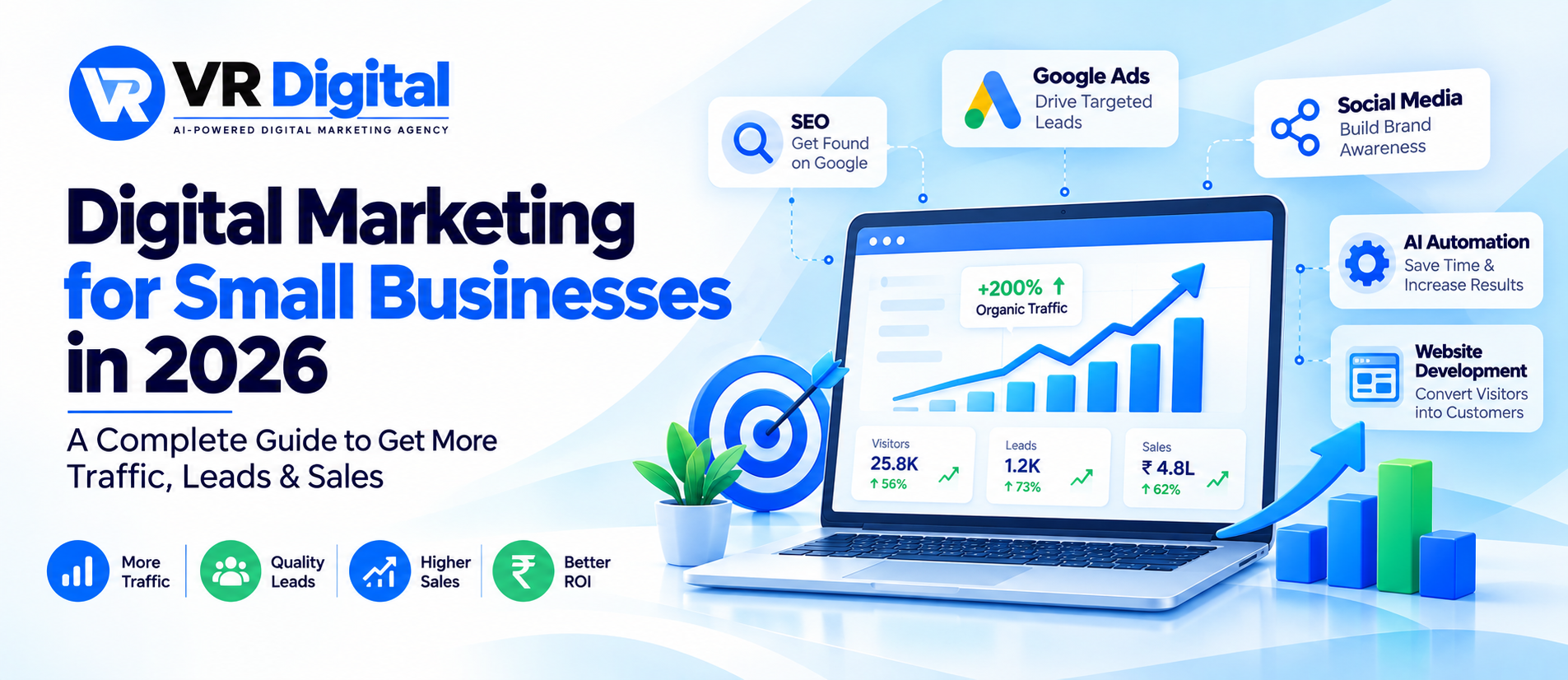
Running digital marketing for small business in 2026 isn’t about spraying budget across every channel. It’s about choosing the few moves that can win in your market, proving them with data, then doubling down while you plug the leaks that waste budget.
If you operate in India, the playbook looks similar to the US or EU, but it isn’t identical. Consumer discovery blends Google, YouTube, Instagram and WhatsApp. UPI lowers payment friction. Regional languages matter. Ignore those realities and results stall, even with good creative.
The 2026 small-business reality in India
Here’s the direct answer—focus on owned assets, measurable funnels and first‑party data. Expect AI‑summarised results to compress some organic clicks, ad auctions to stay competitive, and user patience on mobile to remain low.
What hasn’t changed is intent. People still search when they’re ready, compare a short list, and contact the business that looks fastest, clearer and more trustworthy. So you need sharp positioning, an offer that answers the obvious objections, and a friction‑light path to call, WhatsApp or buy.
What has moved is the bar for clarity. Service pages now need proof points, FAQs and pricing frames. Your Google Business Profile benefits from fresh photos and recent reviews. Content has to be scannable, multilingual where it helps, and structured so AI systems can cite it without guessing.
Channels that reliably drive traffic and leads
SEO and content with intent
Build pages around the problems and services people actually search. Use Search Console to spot gaps, create briefs, and publish one strong page at a time. If you want help with planning, technical hygiene and editorial process, explore search engine optimization services to compound non‑paid traffic over the next 6–12 months.
Paid search (and Shopping for ecommerce) captures live demand. Start narrow. Protect your brand terms, then add a handful of exact or phrase‑match intents with tight ad groups. Send traffic to offer‑led pages, not your generic homepage. Track calls and WhatsApp clicks as conversions, not only forms.
Local visibility that converts
For location‑led businesses, Map Pack presence is often half the battle. Keep NAP consistent, add categories that reflect your services, and ask for reviews after each job. If you need structured help, prioritise local SEO and Google Business Profile optimisation to influence calls, directions and walk‑ins near you.
Use social to seed demand and proof. Short videos showing the work, customer before‑afters, and quick explainers travel well on Instagram and YouTube Shorts. Pair that with remarketing to bring visitors back when they’re ready. WhatsApp Business catalogues and quick replies speed up closing.
AI search, AEO and entity building
AI overviews reward clarity and consistency. The practical move is to make your business an explicit entity online—use the same name, address, phone and categories everywhere; write service pages that state what you do, where you do it and how you do it; and keep an About page that links to official profiles.
Add schema for LocalBusiness, Organization and Service. Publish compact Q&A blocks on key pages that answer the questions prospects actually ask. Show pricing models (from‑to ranges or packages), outline process steps, spell out warranty or return terms, and include trust markers like licenses and memberships. Keep media original, labelled and recent.
If you’ve run a site for years, mine support chats and sales calls for topics. Turn those into FAQs and comparison snippets. You can automate parts of this with tools, but keep a human editor in the loop. AI can draft; only your team knows which promises you can keep.
Build a lean, measurable funnel in 30 days
Tracking and data layer
Set up GA4 with server‑side or standard tagging to fit your stack. Define generate_lead, submit_form, click_call, WhatsApp_click and purchase (if relevant). Use UTM conventions everyone follows. Add call tracking numbers and ensure form leads push source, campaign and keyword into your CRM for closed‑loop reporting.
In GA4, mark primary conversions and build audiences for remarketing (visitors who viewed pricing, cart abandoners, engaged video watchers). Create Exploration reports that break down lead quality by channel and by landing page. In Search Console, watch query growth, CTR and coverage issues weekly.
Landing pages and offers
Every paid click should land on a page that loads fast, states the offer up top, proves credibility and makes contact simple. If you need help turning traffic into revenue, prioritise website development and conversion optimisation to lift conversion rates across all channels you already pay for.
Keep forms short. Offer WhatsApp as a contact option. Add trust badges your audience recognises. For ecommerce, test prepaid vs cash on delivery messaging region by region—behavior varies across metros and Tier‑2 cities. Measure scroll depth and interaction so you’re not guessing where users drop off.
Nurture and automation that respects buyers
Respond to new leads within minutes during business hours. Use WhatsApp templates for common replies, then personalise them. A simple three‑email or WhatsApp sequence can educate, answer objections and ask for a decision. Route leads with n8n to the right rep, set SLAs, and log outcomes back to your CRM for attribution.
Budgets, media mix and realistic timelines
A useful starting point is a split across demand capture (search/Maps), demand creation (social/video) and compounding (SEO/content). If lead quality from social is soft, rebalance toward search until landing pages and offers improve. When you’re ready to orchestrate the whole journey, consider full-funnel performance marketing so channels support each other instead of competing.
Watch leading indicators first—impression share on your best intent keywords, cost per click trends, landing page conversion rate, call connection rate, and time to first response. For organic, use indexed pages, non‑brand clicks and Map Pack actions as early signals. Set ranges you can live with; adjust weekly, not daily.
Common mistakes and quick fixes
- Sending all traffic to the homepage instead of to focused offers.
- Counting any form as a lead without qualifying questions or sales feedback.
- Ignoring Local search photos, categories and review replies.
- Letting creative fatigue drive up CPAs—rotate formats and hooks.
- Skipping multilingual support where it would help conversion.
Creative quality now means clarity more than polish. Show the offer, outcome and next step in the first three seconds of an ad or reel. Use brand‑safe templates, but keep them fresh. If you want a faster way to scale on‑brand assets without bloating costs, explore graphic design with AI to test more concepts in less time.
Finally, don’t overextend tools. A lean stack your team actually uses will beat a fancy one that nobody opens. Document naming conventions, set access right, and schedule short weekly reviews so decisions happen quickly.
Talk to a VR Digital Strategist →
Conclusion
Winning digital marketing for small business in 2026 comes down to clarity, speed and evidence. Pick channels that match intent, build pages that convert, and let data call the reallocations. AI search rewards explicit answers; give it those.
If you want a partner who works this way, VR Digital can help you prioritise, implement and measure without fluff. Start small, prove the unit economics, then scale what’s working while you trim what isn’t.